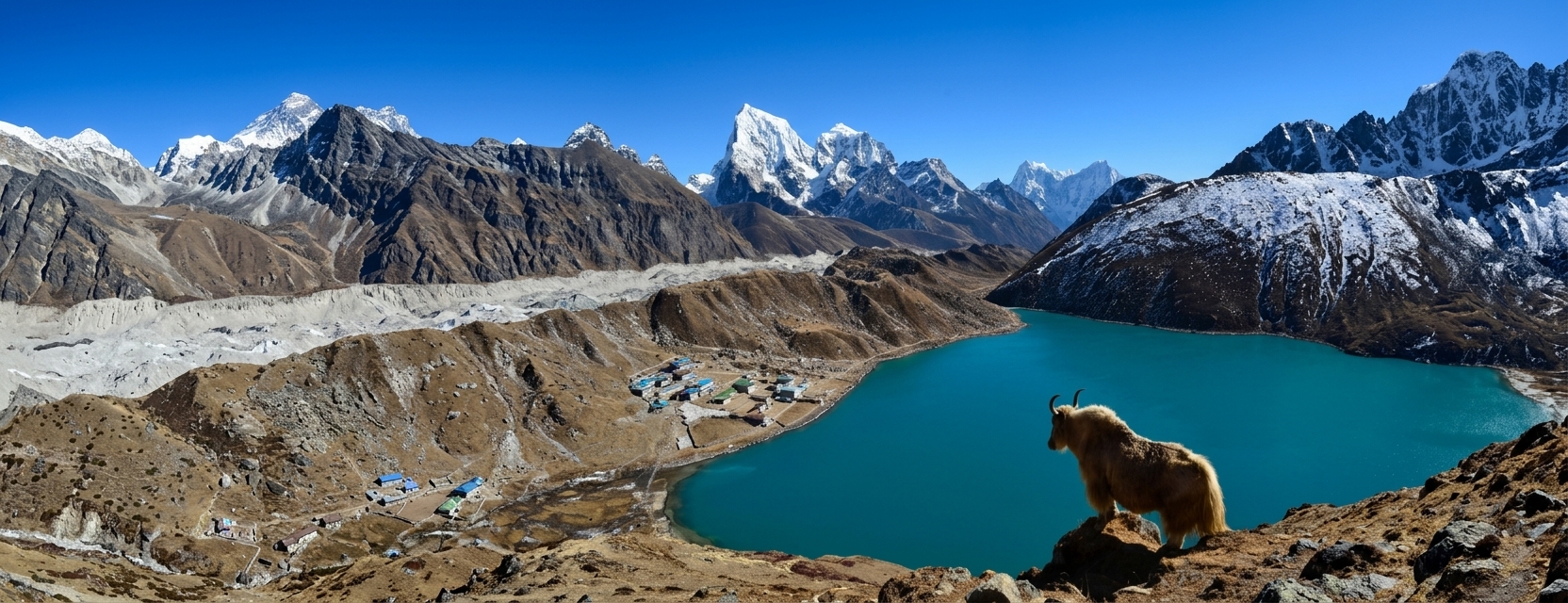
The 14-Day Renjo-La Pass Trek is an adventurous journey through the Himalayan trail. This journey leads you to the Renjo-La Pass, which offers stunning views of Everest, Ama Dablam, Lhotse, and other surrounding peaks, as well as glacial lakes. Trek through the lush forest, alpine meadows, and ancient monasteries, and interact with the Sherpa and enjoy their warm hospitality. Imagine standing at 5,360 meters, the sun rising over Everest, Lhotse, and Makalu, with Gokyo's turquoise lakes sparkling below you—this is the 14-Day Renjo-La Pass Trek. The 14-Day Renjo-La Pass Trek is the best alternative trekking destination to cross the high passes of the Everest region. Witness the colorful prayer flags, mani walls, ancient monasteries, charming Sherpa villages, and the chanting of the monks; it creates a vibrant yet calm atmosphere. Interact with the local people, learn about their unique culture and lifestyle, and enjoy warm hospitality. Immerse yourself in the breathtaking views of the snow-capped Himalayas, including Ama Dablam, Lhotse, Everest, Cho Oyu, and other surrounding peaks, as well as glacial lakes, and enjoy panoramic views of the surrounding landscape. This trek is challenging yet rewarding; adventure-loving trekkers can join the trek and enjoy the beauty of the Everest region
Destination
Nepal
Duration
14 days
Difficulty
Moderate
Activity
Trekking
Accommodation
Hotel
Meals
Breakfast, Lunch & Dinner
Transport
Flight
Start & End Point
Kathmandu
Best Seasons
Mar-June, Sep-Dec
Trip Highlights
Renjo-La Pass: Standing at approximately 5,360 meters, this high mountain pass offers breathtaking panoramic views of iconic peaks such as Mount Everest, Lhotse, and Makalu, providing trekkers with a thrilling sense of achievement.
Gokyo Ri: Located at 5,357 m, it offers perfect views of the surrounding Himalayas, valleys, and local communities.
Gokyo Lake: Famous for its stunning turquoise colour, the series of lakes is perfect for photography lovers.
Stunning Himalayas: Witness the majestic Himalayas, including Everest, Lhotse, and other surrounding peaks.
Renjo-La Pass Trekking Overview
The trek leads you through remote villages, green valleys, and alpine meadows, slowly ascending to the Renjo-La Pass, which reaches approximately 5,360 meters above sea level. The highlight of the Renjo-La Trek is exploring the Gokyo Lakes, a series of crystal-clear, turquoise glacial lakes that are very pleasant to visit.
Trekking along the pathway gives you access to the spectacular views of Everest, Lhotse, Makalu, and Cho Oyu, especially from the pass itself. The stunning views of the dramatic landscape, glaciers, and stunning scenery make it perfect for photography enthusiasts and nature lovers.
Apart from its stunning natural beauty, the Renjo-La Pass trek allows you to interact with the local Sherpa and learn about their unique culture, traditions, and mountain lifestyle. The trek incorporates diverse terrain, including thick forests, and is rated as a moderate-to-hard trek.
The Renjo-La Pass Trek is a trip of a lifetime that combines amazing natural beauty with rich cultural experiences, making it a must for adventurers who want to explore the Himalayas and feel their grandeur.
Come with us! Let's create some unforgettable memories on the Renjo-La trek!
Why Choose the Renjo-La Trek?
Trekking in Renjo La Pass offers a remarkable experience in Nepal's Himalayas, combining raw natural beauty, cultural immersion, and personal achievement. Other passes, besides the Renjo-La Pass, and trekking routes are available in the Everest region.
One of the main reasons an individual should trek the Renjo La Pass is that it is less crowded, offers great views of the Himalayas and glacial valleys, and provides the opportunity to explore Gokyo Lake. The Renjo-La Pass trails are less crowded than other destinations like EBC for trekking in and around the Everest region. It will enable you to get closer to nature in a serene environment.
The Renjo-La Pass is ideal for adventure seekers who love off-the-beaten-path exploration without compromising the natural beauty. Crossing a high mountain pass is itself a big achievement that any trekker loves to experience.
This is one of the best options for adventurers keen to explore the less-visited trekking trails. Nature will congratulate you as you complete the pass and feel a sense of achievement.
Renjo-La Trekking Cost
The price of the Renjo La Pass trek can vary depending on whether you hire a guide or a porter, and the cost of gear and equipment will also affect your overall expenses. You can conveniently rent gear and equipment in Namche Bazaar. Don't forget that miscellaneous items will also impact your total trekking cost.
Boundless Adventure is very happy to provide a group discount for the Renjo La Pass trek! We are open to groups of any size, right from solo trekkers to groups of 15 or more. The more members, the greater the discount one gets.
If you're part of a group planning to trek Renjo La Pass, reach out to Boundless Adventure via WhatsApp at +977 9851033819. We can also help reduce costs for solo trekkers.
Let us help you plan an unforgettable adventure!
Day-to-Day Short Itinerary
Day 01Picks up and drive to Hotel 1380 Meters1,400m~0.25 hrs
Day 02Flight to Lukla - Trek to Phakding 2656m2,860m~0.75 hrs
Day 03Trek to Namche Bazaar, 3450m3,450m~5 hrs
Day 04
What is included in this trek package?
What's Included
Airport pickup and drop-off by private car, van, or bus.
Three meals daily (breakfast, lunch, and dinner) during the trek.
Witness the breathtaking panoramic views of the snow-capped Himalayas of the Everest region. Throughout the journey to Renjo La Pass, trekkers will be pleased by the mesmerizing beauty of the mountain peaks, including Mount Everest (8,848 m), Lhotse (8,516 m), and Makalu (8,485 m). Moreover, the snow-capped peaks of Mount Cho Oyu (8,188 m), Nuptse (7,861 m), Pumori (7,161 m), Ama Dablam (6,856 m), Thamserku (6,723 m) and many unnamed peaks are also scenic. These stunning beauties create unforgettable memories for a lifetime.
Renjo-La Pass
Crossing the Renjo-La Pass (5,360 meters) is one of the trek's highlights. Reaching the top of the path is quite challenging, but the views from the top of the pass make the trek worth it. The moment you are at the top of the pass and get to see the beautiful sight of the surrounding peaks and valleys from there, it makes all the difficulties in trekking nothing but mere memories to be cherished forever.
Gokyo Valley
Exploring Gokyo Valley is a must. Gokyo Valley is renowned for its stunning turquoise glacial lakes, including the famous Gokyo Lakes. Trekkers must explore the valley and a series of lakes, which offer picturesque views and a great spot for photography. Gokyo is home to a small community of Sherpas and serves as a hub for trekkers and climbers heading towards the Everest region. The valley is surrounded by towering peaks and provides a serene environment for exploration and relaxation.
Gokyo Ri
Hiking to Gokyo Ri is the highlight of the Renjo-La Pass Trek of the Everest region. The ascent offers one of the best panoramic views of the Everest region, including a breathtaking vista of the Gokyo Lakes below and the surrounding peaks. A view of the towering mountain ranges with the Gokyo Lakes in the background creates a breathtaking scene, and the best time to get this view remains the time of the rising sun that shines with gold on the landscape.
Diverse Landscapes
The route of the Renjo-La Pass trek is variable as far as the landscape is concerned. Trekker treks from the terraced land, the forest, and several villages at a low elevation, to the mountain and glacial lakes. This trekking journey allows trekkers to enjoy the diverse landscapes of this region. Each segment of the trek presents unique scenery, showcasing the natural beauty of the Everest region.
Cultural Exploration
The trek to Renjo La Pass is in the Everest region. The region is known for the unique culture and tradition of the Sherpa people, so trekkers have an opportunity to immerse themselves in the area’s culture and tradition. Visiting local homes and participating in cultural activities provides a deeper understanding of the Sherpa way of life. Your trekking trail passes through traditional Sherpa villages and Buddhist monasteries, including Tengboche and several other small and large monasteries on the trail, providing a chance for cultural exploration.
Diverse Flora and Fauna
The Renjo La Pass Trek is biologically diverse. Trekking along the dense forest trail of the Sagarmatha National Park, adventurers are able to witness several species of wildlife, birds, and the exclusive vegetation and species of this particular region. This section of the region is known for the habitat of rare species like the Snow Leopard, Red Panda, several species of birds, along with several species of flowers, mainly in the spring season when the blooms of the rhododendrons attract several visitors to this destination.
Gokyo
Gokyo is a stunning village located in the Khumbu region of Nepal, situated at an elevation of approximately 4,790 meters (15,700 feet). It serves as a key stop on the Renjo-La Trek and is renowned for its breathtaking scenery and serene atmosphere. Trekkers hike to Gokyo Lake, the highlight of the trek. It is famous for the turquoise colour it possesses, with the surrounding high peaks and glaciers.
The region consists of a Sherpa settlement because it is an important point from which people trek to the Everest region. The village has a rich cultural heritage, with traditional stone houses and a peaceful ambience.
There is the Gokyo Monastery in the village, which is a religious center where trekkers can learn the traditions and be in the mystical environment that the Himalayas possess.
Gokyo Ri
Gokyo Ri is a prominent peak that rises to an elevation of 5,357 meters (17,575 feet) and offers one of the most spectacular viewpoints in the entire Everest region. The ascent to Gokyo Ri is a must-do for trekkers, as it provides panoramic views of the surrounding mountains, including Mount Everest, Lhotse, Makalu, and Cho Oyu. The sight of these towering peaks against the backdrop of the Gokyo Lakes is truly breathtaking, especially during sunrise when the first light casts a golden glow over the landscape.
The trek to Gokyo Ri is moderately difficult. It requires some level of pace, but reaching Gokyo RI is worth more than being on a luxurious sofa. Take on this trek to experience nature presented in its most beautiful form.
Gokyo Ri is a photographer’s delight, as it offers innumerable chances to click the majestic view of the Himalayas. The sighting from the top is termed to be among the finest in the entire world, thus making it the peak of the trekking expedition.
The Renjo-La Pass Trek ranges from moderate to challenging. This trek is not very commercialized, but the peaceful and calm trekking trail allows trekkers to witness the stunning landscapes and majestic Himalayas.
The Renjo La Pass is 5360 m/17585 ft above sea level, so altitude sickness can be a concern for trekkers. Therefore, while trekking, paying attention to your body is necessary. Acclimatization is the most crucial aspect of giving your body time to adapt to changes in temperature and environment.
Safety Measures
The Renjo-La Pass is a challenging trek, which requires good mental strength and physical stamina. There is a high chance of altitude sickness; trekkers must be careful. They must obtain some safety measures:
Proper Acclimatization
Drink Plenty of Water
Guided by an experienced Guide and Porters
Carry First Aid Kit Box
Keep Emergency Contact
Trek with Group
Listen to Your Body
Trekking in the Renjo-La Pass during spring (March-May) and autumn (September-November) is a perfect choice for any trekker to make. Both of these seasons offer the stunning beauty of the Himalayas, lush hills, and valleys that look crystal clear.
Spring (March to May)
Spring is a popular time for trekking due to mild weather, with temperatures gradually warming and sunny days becoming more frequent. This season is also marked by blooming rhododendrons and other wildflowers, adding vibrant colours to the landscape and enhancing the scenic beauty.
The trails are less crowded compared to autumn, providing a more tranquil trekking experience, although occasional rain may occur as the season progresses. Additionally, wildlife becomes more active during this time, offering opportunities for sightings.
Autumn (September to November)
Autumn offers stable weather conditions and clear skies, with crisp air and excellent visibility of the mountains after the monsoon season. This period tends to attract more trekkers, especially in October, creating a lively atmosphere on the trails. The days are warm, but temperatures can drop significantly at night.
Moreover, autumn coincides with major festivals in Nepal, such as Dashain and Tihar, allowing trekkers to immerse themselves in local culture and celebrations.
Winter (December to February)
Winter in Nepal brings extremely cold temperatures and heavy snowfall, making trekking in high-altitude regions like Everest generally unsafe. Trails can become treacherous due to snow and ice, increasing avalanche risk, and many teahouses may close, limiting accommodation options. While lower-altitude treks are possible with proper gear and planning, winter offers stunning snow-covered landscapes and solitude for those seeking a unique experience.
Monsoon (June to August)
The monsoon season in Nepal, from June to August, is marked by heavy rainfall, especially in lower regions, making it an unsuitable time for trekking in the Everest area. The trails can become slippery and hazardous due to landslides and poor visibility. Heavy rains may also cause flight delays and cancellations. However, this season brings lush greenery and vibrant flora, and some trekkers choose lower-altitude routes that experience less rain, but preparation is essential to navigate the challenges effectively.
Sleeping in a comfortable and well-facilitated hotel and eating well-cooked food full of nutrients and carbs is essential for trekkers. As you trek to higher elevations, the facilities for accommodation and options for food are very basic and limited.
You’ll be eating in a local teahouse, which serves freshly cooked warm meals. The options for food are very few. They serve you dal bhat, momo, pasta, some authentic Sherpa cuisine, Tibetan bread, chapati, and many other available foods. For breakfast, you’ll be eating varieties of tea, soups, curry, chapati, Tibetan bread, egg items, and many more.
For accommodation, you’ll get a small, cozy, but warm bedroom that has a wooden bed, a mattress, a blanket, and a pair of pillows. There are no such facilities as bedroom cheating, private bathrooms, and internet facilities. The teahouses have very basic facilities, but they serve with love and a homely environment.
In city areas, you’ll get a variety of food options with the best accommodation places. You’ll get authentic Nepali cuisine along with some international cuisine. Also, you can enjoy the street food of Nepal and explore from place to place. For bedding, you’ll be sleeping in a private room with an attached bathroom and with all modern amenities.
When trekking in the Renjo-La Pass, obtaining the necessary permits is essential. Here are the permits required for the trek to Renjo-La Pass:
Sagarmatha National Park Entry Permit
Trekker’s Information Management System
These permits can be obtained from the Nepal Tourism Board office in Kathmandu, or we can arrange all these for you if you provide your photos and other paper documents.
Travel insurance is essential while trekking in the high-altitude region. You must select the best insurance company that will help take care of medical coverage, evacuation in case of emergencies, flight problems of delays/cancellations, and the loss of your luggage. Also, ensure that the insurance covers helicopter evacuation.
We suggest you get insurance with a well-reputed and trusted insurance company that provides comprehensive coverage tailored for trekking adventures. Read the agreement before signing and sign the agreement.
The Renjo-La Trek offers some of the most breathtaking Himalayan views in the Everest region. At an elevation of 5,360 meters, Renjo-La Pass is one of the trek's most iconic viewpoints.
From this vantage point, trekkers are rewarded with sweeping panoramas of the surrounding peaks, including Everest, Lhotse, Makalu, Cho Oyu, Ama Dablam, and many other surrounding peaks. Also, trekkers can explore the Gokyo Lake and Gokyo Ri, which offer one of the best panoramic views in the region, showcasing the Gokyo Lakes below and the majestic peaks surrounding them.
Not only the magnificent Himalayas, but also the stunning landscapes, lush green forests, and stone-paved trekking trails can be witnessed by trekkers. The transition from lower altitudes with green terraced fields to the stark, high-altitude environment of the Himalayas is visually stunning and showcases the region's diverse ecosystems. Passing through several Sherpa communities allows trekkers to experience local warm hospitality.
The Himalayan views from the Renjo-La Trek are nothing short of spectacular, offering trekkers a visual feast of towering peaks, serene lakes, and dramatic landscapes. Each step of the journey reveals new vistas, making it an unforgettable adventure for nature lovers and photography enthusiasts alike.
If you are an adventure lover, then this Renjo-La Pass trek is perfect for you. The Renjo-La Pass trek is a moderate to challenging trek in the Everest region. This trek is quite difficult for the beginner to achieve the summit, but with proper preparation and an experienced guide, trekkers can achieve this trek.
The trek starts with a scenic flight to Lukla. Start trekking through Namche, Dole, Machhermo, Gokyo, Lungden, Thame, and Monjo, and back to Kathmandu via Lukla. The trail condition is quite well-maintained, but as you ascend your trek, there's a very high chance of altitude sickness. So, plan your itinerary considering acclimatization days in Namche and Gokyo.
Trekkers can enjoy stunning views of the Himalayas, including Everest, and trek through diverse landscapes. Passing through several local Sherpa villages offers a unique opportunity to experience the vibrant culture and traditions of the rural communities, allowing you to interact with friendly locals, learn about their way of life, and even sample traditional Sherpa cuisine. This cultural immersion adds depth to your trekking experience, making it not just a physical journey but also a meaningful exploration of the region’s heritage.
Overall, the Renjo-La Trek is ideal for adventurous spirits, moderately fit individuals, cultural enthusiasts, and nature lovers who appreciate stunning landscapes and want to witness the majestic beauty of the Himalayas up close.
Trekking with a guide and a porter is a very good experience while trekking to the Renjo La Pass. An expert guide and a porter add to the fun of trekking, along with information about the places.
Guide
An expert guide enables the trekker to visit the places, meet the people, and know the culture and traditions of the people of the Sherpa community, as they will help you on the trail, along with keeping you safe, as the trek to the Renjo La Pass is a high-altitude trek, and you might face unfortunate situations.
Porter
Porters are very important for making your trekking adventure an easier one. They will be carrying your bags for you. They also work very closely with the guides that accompany you on the trek. They ensure that the trekking process goes very smoothly.
By choosing to trek with Boundless Adventure, you can be assured that you’ll have a supportive team by your side, making your adventure both enjoyable and memorable.
In case you are planning to go on a spontaneous trip to Renjo-La Pass, get ready to enjoy a real delight! There might be quite a challenge to get a place reserved this close to the date, but Boundless Adventure will have experts who will arrange everything for you and even offer you competitive prices.
Even with very short notice periods, we prioritize providing each of you with the best possible individualized adventure that would make your stay within the awe-inspiring surroundings of the Everest region an adventure you would always remember. It’s but an email away!
At Boundless Adventure, we ensure a seamless trekking process in Nepal. Our friendly and knowledgeable staff members assist you with all your questions and preparations to embark on your journey. You can focus on your preparations to go on the adventure while we take care of all your other aspects to make your journey smooth.
Transparency is something we take pride in, which is why you can rest assured that our cost structure is straightforward, without any surprise charges. What you're looking at when you check out our site is exactly what you will pay. At Boundless Adventure, you can look forward to having a hope-filled adventure experience that will fit your pocket.
Choose Boundless Adventure for your trekking adventure today!
Packing the right gear for the Renjo-La Pass Trek is essential. Here is the list of items:
Clothing
Waterproof and windproof jacket and pants.
Fleece Jackets
A down jacket
Thermal underwear (top and bottom)
Hiking trousers
Hiking shirts
Warm hat
Sun hat
A pair of gloves
Footwear
Five pairs of socks
Sturdy hiking boots
Comfortable walking shoes
Backpack
40-50 liter backpack
Rain cover for backpack
Sleeping bag (rated for 0°C to -20°C)
Personal Hygiene
Toiletries (toothbrush, toothpaste, wet wipes, hand sanitizer, etc.)
Quick-drying towel
Sunscreen (SPF + 30 to 50)
Lip balm
Insect repellent
Personal medications
Miscellaneous
Headlamp or flashlight (with extra batteries)
Trekking poles
Water bottles or hydration system
Sunglasses (with UV protection)
Camera or smartphone (with extra batteries/charging cable)
Renjo La Pass is located in the Everest region within Sagarmatha National Park of Nepal. It lies east of Nepal and north of Namche Bazaar in the Khumbu region. The Pass is located right north of the Gokyo Lake.
Lukla is the gateway to all the trekking destinations in the Everest region. Thus, you must first get to Lukla Airport to start the Renjo La Pass Trek. After arriving in Lukla, you can start your journey to Renjo La Pass.
Yes, we need to fly from Kathmandu Airport to Lukla Airport. It's a 45-minute flight from Kathmandu's domestic airport to Lukla's airport. After arriving in Lukla, you'll begin trekking and reach your final destination within nine days.
The Renjo La Pass is 5360 m/17585 ft above sea level. It is one of the three high passes in the Everest region and is known for its stunning, picturesque views of the surrounding Himalayan peaks, including Mount Everest, the world's highest peak.
Yes, we'll depart from Lukla Airport for Kathmandu at the end of your travel days. Of course, your guide will handle plane tickets to reconfirm a day earlier. The flight from Lukla to Kathmandu Airport is 45 minutes, and a van/car will take you to your Hotel.
"La" is the term that locals of the Himalayas use. The word "la" is derived from Tibetan and means "pass." La is a pass that allows passage from one side of the Himalayas to the other.
Yes, you can visit Gokyo Lake during the Renjo La Pass trek, as it is located in the Gokyo Valley along the trekking route. Your journey to the Pass of Renjo La begins with a trek from Lukla, passing through the Sherpa settlement, and reaching Gokyo Valley. We have included a full day on the itinerary for exploring Gokyo Valley and Gokyo Lake.
As the Renjo La Pass doesn’t require any technical climbing sections, ropes are generally optional. Also, if you are trekking during the spring and autumn seasons, you can go through the Pass without ropes. Your guide will look after your situation.
Yes, a sleeping bag is necessary for the Renjo La Pass trek. The temperature drops to below zero degrees Celsius at night in the Everest region; therefore, a sleeping bag ensures warmth and comfortable sleep.
The best seasons for the Renjo La Pass trek are spring (March to May) and autumn (September to November). Spring and autumn provide ideal trekking conditions with stable weather and clear skies.
Trekking Condition FAQs
The trek is moderate in difficulty, with challenging sections above 4,000 meters. Trekkers should be prepared for rocky, uneven trails, especially as they approach higher elevations.
Crossing the Renjo La Pass depends on the trekker's pace and fitness level, the weather, and the Pass's starting point. It generally takes 4 hours to reach the top of Renjo La and another 3 hours to descend to Lundre, starting from Gokyo Valley.
Acclimatization days are included in the itinerary, particularly in Namche and Dingboche. Staying hydrated, ascending slowly, and being aware of altitude sickness symptoms are crucial for a safe trekking experience.
Yes, there is a high risk of altitude sickness above 3,500 m. Ascend slowly and take time to rest during the trek.
Renjo La Pass is at 5,360m, making it one of the most challenging treks. The Pass’s high altitude reduces oxygen levels and increases the risk of altitude sickness. The trekking trail is moderated with less snow and ice, but it is difficult to cross when there is too much snow.
You'll be walking for 5-8 hours daily.
If you trek in spring and autumn, the weather is ideal. Clear, crisp, and warm weather makes trekking comfortable.
Yes, the rest days are included in the itinerary. You'll stop in Namche and Gokyo for acclimatization.
In the event of a health issue, you descend to a lower elevation, and in an emergency, a helicopter evacuation will be conducted.
Booking and Cancellation FAQs
You can book the trek by contacting Boundless Adventure through our website or via WhatsApp at +977 9851033819. We will guide you through the booking process.
Our cancellation policy outlines the refund terms based on when you cancel your booking. Please check our website for detailed information regarding cancellations.
Last-minute bookings are possible, but they may incur additional costs and limit your preparation time. It is advisable to plan your trek.
It is recommended to book your trek at least 2-3 months in advance, especially during peak trekking seasons (spring and autumn), to ensure availability and secure the best accommodations.
Date changes may be possible depending on availability. Communicate with the agency and make sure about your dates.
Guide and Porters FAQs
Yes, you'll have an experienced guide who will assist you throughout your trek in the Everest region.
Porters carry heavy backpacks and equipment, alleviating the physical burden on trekkers and allowing you to focus on enjoying the journey.
Boundless Adventure employs trained, experienced guides and porters who are familiar with the trails and conditions in the Everest region.
Yes, tipping a guide is recommended.
Yes, they have sound knowledge about the first aid kit. In case of an emergency, they use it.
Typically, one guide is assigned to a group of 4-8 trekkers to ensure personalized attention and safety.
They speak different languages. Nepali, English, Hindi, Spanish, Chinese, French, and many more languages based on their knowledge.
Yes, guides are available to answer questions and provide support throughout the trek.
Permit and Travel Insurance FAQs
You will need the Sagarmatha National Park Entry Permit, Khumbu Rural Municipality Permit, and Trekker's Information Management System (TIMS) Permit.
Your trekking agency can arrange all necessary permits for you, or you can obtain them from the Nepal Tourism Board office in Kathmandu.
Yes, comprehensive travel insurance is highly recommended. It should cover high-altitude trekking and emergency evacuation.
Ensure your insurance covers trip cancellation, medical emergencies, and helicopter evacuation.
While it’s possible, it’s not advisable due to the risks associated with high-altitude trekking.
Cost and Visa FAQs
Yes, most travellers require a visa to enter Nepal. You can obtain a visa on arrival at Kathmandu's airport or apply for an e-visa online before your trip.
To apply for a visa to Nepal: On Arrival: Fill out the visa application form at the airport, provide a passport-sized photo, and pay the visa fee in cash. E-Visa: Visit the official Nepalese government website to apply for an e-visa. You will need to upload a passport-sized photo and pay the visa fee online.
Yes, your passport should be valid for at least six months beyond your intended date of entry into Nepal.
Yes, you can extend your visa at the Department of Immigration in Kathmandu or Pokhara. Extensions are subject to approval and may incur additional fees.
The cost of the Renjo La Pass trek depends on several factors, including the services included in the package, the trek duration, and group size. Typically, the price ranges from USD 1,250 to USD 1,680 per person. The cost covers three meals a day, accommodation during the trek, air transportation, a guide, and required permits.
Yes, a group discount is available for the Renjo-La Pass Trek. Contact your travel agency to confirm the group size and applicable discount.
Advanced booking is recommended for trekking. During peak season, it's tough to find a trekking package on short notice.
Food and Accommodation FAQs
Expect a variety of food options, including traditional Nepali dishes and international cuisine, such as rice, lentils, and vegetables.
Accommodation consists of local teahouses that offer basic but comfortable lodging. Private rooms are available in lower elevations.
Most teahouses offer Western food options, but as you move higher, availability becomes very limited. At lower elevations, you can enjoy a variety of Western food options.
Yes, most teahouses cater to dietary preferences, including vegetarian and vegan options.
Yes, teahouses offer snacks such as chocolate, biscuits, and other items you can purchase and enjoy.
Electricity is available in lower elevations but may be limited in higher areas. Charging devices may incur a small fee.
Bathrooms are typically shared and may be squat-based in teahouses, especially at higher altitudes.
Laundry services are available at some teahouses in lower villages, but they are limited. At higher altitudes, it’s best to bring quick-drying clothes and do basic hand-washing yourself.
Wi-Fi is available in most villages, but speeds are low. Mobile network coverage is limited above Namche.
Packing and Preparation FAQs
You should pack moisture-wicking shirts, thermal underwear, a warm fleece or down jacket, a waterproof and windproof jacket and pants, trekking pants, a sun hat, warm gloves, and several pairs of socks (preferably wool or synthetic).
It is essential to have sturdy trekking boots that provide good ankle support and traction. Additionally, pack camp shoes or comfortable slippers for use at teahouses.
Yes, a high-quality sleeping bag rated for cold conditions is recommended, as accommodations at higher altitudes may not provide adequate bedding.
Essential gear includes a backpack (30-50 liters), trekking poles, a headlamp or flashlight, a first aid kit, and a water bottle. You may also want to carry a quick-drying towel and snacks.
Yes, it’s important to pack sunscreen, sunglasses, and lip balm to protect against sun exposure at high altitudes. A camera or smartphone for photos is also recommended, along with extra batteries or a portable charger.
Avoid bringing unnecessary heavy items, such as large amounts of clothing or valuables. Focus on lightweight, multi-purpose gear to keep your pack manageable.
Cultural Consideration FAQs
Greet locals with "Namaste," dress modestly, and ask permission before taking photos of people or sacred places.
Yes, tipping is customary in Nepal. It’s a way to show appreciation for their hard work and support.
Familiarize yourself with local customs, such as removing shoes before entering homes and monasteries.
Be respectful, friendly, and polite. Engage with locals but be mindful of their privacy and customs.
Yes, if your trek coincides with local festivals, it's an excellent opportunity to experience the Sherpa people's culture and traditions.
Let's Plan Your Trip Together
Tell us what you're looking for, and we'll help you shape a journey around it.
Diverse Landscapes: Trek through lush forests and terraced fields to the rugged Himalayan terrain. This trek offers diverse landscapes of the Everest region.
Nepali Hospitality: Trekkers experience the warmth of Nepali hospitality, where Sherpas welcome them warmly and serve food with care.
Adventure Trek: Combines physical challenge with stunning scenery, making it ideal for outdoor enthusiasts seeking an unforgettable experience in the Himalayas.
Photographic Opportunities: Breathtaking landscapes, vibrant cultures, and stunning mountain vistas make the trek a photographer's paradise, offering numerous opportunities to capture the beauty of the Everest region.
Acclimatization Day 3800 meters
3,450m
~4 hrs
Day 05Trek to Dole, 4040 Meters4,040m~5 hrs
Day 06Trek to Machhermo 4470 meters4,470m~4 hrs
Day 07Trek to Gokyo 4700 Meters4,700m~4 hrs
Day 08Explore day, Gokyo-Ri (5360m)5,360m~4 hrs
Day 09Trek to Lungden, 4380 meters4,380m~8 hrs
Day 10Trek to Thame, 3800 meters3,800m~5 hrs
Day 11Trek to Monjo, 2835m2,835m~5 hrs
Day 12Trek to Lukla2,860m~4 hrs
Day 13Fly to Kathmandu.1,400m~0.75 hrs
Day 14Final Departure.1,400m~0.25 hrs
Lukla Flight Information
During peak trekking months (March, April, May, October, and November), flights to Lukla often depart from Ramechhap (Manthali) instead of Kathmandu because of airport traffic. In this case, you'll need to leave Kathmandu around 12:30 a.m. for a five-hour drive to catch your flight from Ramechhap on the trek departure date. Outside of peak seasons, flights usually operate directly from Kathmandu. Flights between Kathmandu and Lukla can be delayed due to weather, so adding at least two extra days to your trip is a good idea to avoid missing your international flight home.
Note
We recommend you arrive at Kathmandu by three pm at least one day before the trek departure date for last-minute preparations.
Detailed Itinerary
The itinerary below outlines a 14-day hike from Kathmandu to Gokyo Lake and Gokyo Ri via Renjo La Pass. The highest viewpoint for trekking is Gokyo Ri, located in the Everest region at 5360 meters above sea level. The hiking season for the trek runs from March through June and from September through December. The trip begins with a short flight from Kathmandu to Lukla Airport, where it continues.
It is recommended to book your flights to and from Lukla in advance. Due to limited ticket and aircraft availability, availability cannot be guaranteed. Please note that while we do not mind you booking your own flights, below is the 14-day itinerary for the Renjo La Pass trek from Kathmandu to Gokyo Lake and Gokyo Ri in the Everest region. Gokyo Ri, standing at 5360m above sea level, offers the highest viewpoint for trekking. This trek is available for hiking from March to June and September to December.
The journey begins with a short flight from Kathmandu to Lukla Airport, and the trekking itinerary spans 12 days, starting on the 2nd day and concluding on the 13th day in Kathmandu.
Day 01
Picks up and drive to Hotel 1380 Meters
Kathmandu Metropolitan City
Max Altitude
1,400m
Duration
0.25 hrs
Transport
Private vehicle
Meals
null
An airport representative will be at the Tribhuvan International Airport exit with a Boundless Adventure arrival board and your name card, even if you arrive late at night. Please note that if you would like a Nepali local SIM card, you can obtain one quickly at the airport with a photo ID.
Drive to Kathmandu's domestic airport, board, and fly to Lukla, where you'll see beautiful views of the Langtang and Manaslu Himalayan Ranges. After 45 minutes, you will land in Lukla, meet your porters, and continue the trek to Phakding (2656m). Hiking from Lukla to Phakding will take around 3 hours. You will have lunch in Phakding and rest at the Hotel for a full day; in the evening, you may explore the local village and rivers. However, have dinner at the Hotel and stay overnight in Phakding.
Accommodation
Hotel
Start the trek to Manche Bazaar after breakfast in Phakding. Continue the trek through the Bank of River, Banker, Manju, and Jorshelle. You can see Mount Thamserku from Banker. And get to Manju right after crossing the suspense bridge. There is a National Park Check post . We need to check in permits and continue to Joeshalle. Have lunch at the Joeshalle and trek to Namche Bazaar (3450m). We need to climb up right after the last bridge. The climbing part is switched back up. You should bear with some animals completely. You will have a chance to glimpse Mount Everest from the bridge halfway to Namche. Have dinner at the Hotel and overnight in the Hotel or tea house.
Accommodation
Hotel
Today is a superb day to see Mount Everest. Just trek on the right after breakfast from Namche. Hike on with a day bag and windproof jacket up to 3800 meters above sea level. The first view will be Mount Everest, the descent to Khumjung village, and the monastery. After the best view of Mount Everest, Mt.Lotshe, Mt.Nuptse, Mt. Amadablam, and neighbors' peaks, explore the Khumjung village, school, and monastery. However, you can see the Yeti skull at Khumjung Monastery. Have lunch in Khumjung village, then descend to the Manche bazaar via Yak Pharm in Shyangbouche. Overnight at the Hotel in Namche Bazaar.
Accommodation
Hotel
Dole is a small village. After the warm breakfast at the Manche Bazaar, the trail continues through Khumjung village. On the second day, you will see the view of Everest. It is 4040 meters above sea level. Continue towards Phorthe Tenga via mani walls, rhododendrons, and pine forests. Once you reach the Tenga, have lunch, then continue trekking to Dole. Dole has not had many lodges and needs to book them in advance. Have dinner in Dole and stay overnight.
Accommodation
Guesthouse
Start from Dole at 7:30 or 8:00 AM after breakfast. The trail is easy to walk through the genital path. It usually takes 5 hours to get to Machhermo. You may have beautiful views of the Himalayas. Have lunch at Sherpa Lodge in Luja and overnight at the Machhermo.
Accommodation
Hotel
Trek to Gokyo? Yes, it is another exciting day. Start the trek at Gokyo Valley and Lake. Trekking from Machermo to Phang at 4,480 meters, one encountered massive avalanches in 1995. Right after the Phang, you will get a small lake named Taujung Lake, and 200 meters higher, you will get Gokyo Lake. It is a gorgeous lake; It is 43 meters deep. However, you will enjoy the Lake and the Hotel near the lake. Have lunch and explore the Lake. Overnight at the Hotel
Accommodation
Hotel
Early morning hike up to Gokyo-Ri (5360m) for sunrise views over Mount Everest, Cho Oyu, and Mount Makalu, and back to Gokyo Lake. It usually takes around four hours for a side hike. Have lunch and a rest day; similarly, there are a few more lakes that are higher than Gokyo Valley. If you feel comfortable, you can hike another three hours one-way and return overnight to the Gokyo Valley.
Accommodation
Hotel
Start early in the morning from the bank of Gokyo Lake with plenty of drinking water and dried fruit; a headlamp is also necessary. It usually takes 4 hours to reach the top of Renjo La (5360m) from Gokyo, and another 3 hours to reach Lungde (4380m), though the trekking trail is still a bit easier. Trek slowly and catch your breath along the trail. There are superb views of Mt. Everest, Mt. Makalu, Mt. Cho Oyu, Amadablam, and many unnamed peaks. Similarly, we need to descend to Lunde along yak-grazing trails. Have lunch at the Lumde; you will have the rest of the day free. Have dinner in the evening and stay overnight at the Guest House.
Accommodation
Hotel
Thame is a small village in the Khumbu area. Here, most Buddhists live. Most people are dependent on tourism and small farms. But it is very famous for a day hike from Namche Bazaar. From Lungden, there are two different trails. One trail leads to the Tibet border, and another to Thame. From Lungden to Thame, it will take 5 hours, including a short break and lunch. The trail mostly follows the stream. Have lunch at the Thame and explore the monastery. Have dinner and stay overnight at the guest house.
Accommodation
Hotel
Yes, trek to Manjo today at 2835m. The trekking trail is easy to Namche Bazaar, where you can have lunch, and then return to Manjo. Hopefully, you remember the trekking trail you climbed on the second day of the trip. We must descend to the River, cross it several times, and reach the checkpoint. We will stay overnight after the check-post to have a warm dinner.
Accommodation
Hotel
Breakfast, Lunch, and Dinner Included
Today is the last night of the Renjo-La pass trekking on Everest in Nepal. However, trek down to Phakding and gradually climb up to Lukla. We will have lunch at the Thado Koshi. And continue towards Lukla. It takes five hours to get to Lukla from Manjo. You may check into the hotel and rest, but the guide will go to the airline to reconfirm the tickets to take off from Lukla to Kathmandu the following day. You will meet your trekking crew at 5:00 PM to review the trip and provide tips. Have fun, and enjoy the last night with every team.
Accommodation
Hotel
Have breakfast at the Hotel in Lukla, and your crew will help you drop off all logged-in passengers at the Airport in the morning. You will fly to Kathmandu within an hour, and your vehicle will be waiting at the domestic airport. Similarly, you will drive to a Hotel in Kathmandu. Have a free day in Kathmandu.
Accommodation
null
Have breakfast in the Hotel, and our representative will depart for the international airport by car, van, or bus. Please note: Check-out time is noon. If your flight is in the evening or late at night, please talk to the Hotel.