



Khumbu Glacier at 4900m-7600m: Discover Everything You Need to Know
Ask Question
Every year, thousands of trekkers and climbers journey to the Mount Everest region, drawn by the promise of stunning landscapes and towering peaks. Yet few realize that one of the most powerful natural forces shaping this terrain lies beneath the surface: the Khumbu Glacier. For those who don't know much about the river of ice, it can look challenging to cross or grasp. Why did it start to happen? Is it safe to go trekking? In what way do local and global ecosystems depend on plants?
This ignorance may result in lost chances or, worse, risky travel choices. It is a living, moving Glacier that narrates Earth's history and future, not just another frozen trail. Knowing the Glacier is crucial whether you're an avid hiker, an inquisitive tourist, or someone organizing the Everest Base Camp Trek.
Let's melt the mystery away—step by step—and discover everything you need to know about this icy giant, also known as Khumbu Glacier/Icefall.
Where is the Khumbu Glacier located, and why is it geographically significant?
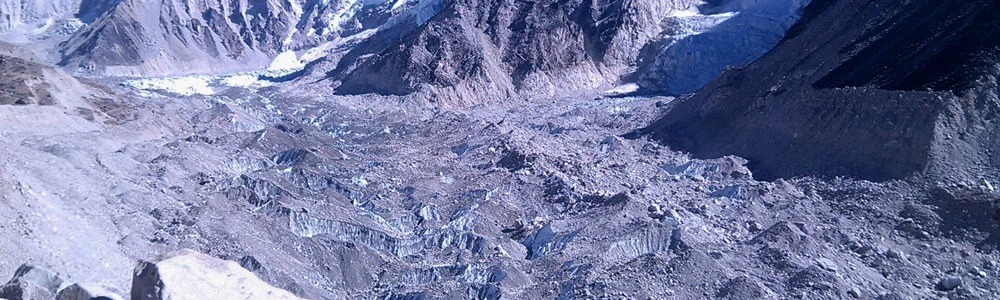
The Khumbu Glacier is nestled in the heart of the Mount Everest region, forming part of the upper reaches of the Khumbu Valley in northeastern Nepal. This Glacier flows from the Western Cwm, situated just below Everest, all the way down past Lobuche.
At altitudes ranging from approximately 4,900 meters (16,000 feet) at its terminus to 7,600 meters (24,900 feet) at its origin, the Khumbu Glacier holds the title of the highest Glacier in the world. Its proximity to Everest makes it an integral part of high-altitude expeditions and a dominant feature on the map for trekkers venturing toward the base of the world's tallest peak.
Its existence has influenced the precise path taken by many explorers, acting as both a challenge and a destination. It is not merely a beautiful sight. Many local Sherpas refer to it as the "cold spine of the Everest trail" because it reminds them that even ice may affect fate.
5 Facts of Khumbu Glacier
Before moving further, here are some intriguing facts about the Khumbu Glacier:
- It is the highest Glacier on Earth, spanning altitudes from 4,900 to 7,600 meters.
- The Glacier moves several centimeters every day, constantly changing its shape.
- The Khumbu Icefall is one of the most dangerous sections of the route due to its unstable ice formations.
- Layers of ice reveal a climatic history that spans thousands of years.
- Despite its harsh environment, the Glacier supports an ecosystem adapted to extreme conditions.
The Formation Of The Glacier And Its Significance To The Region
Over thousands of years, compacted snowfall high in the Himalayas created the Khumbu Glacier. Snow gradually flows downward under its own weight as it accumulates and solidifies into ice, shaping the surrounding terrain as it goes. Valleys have been sculpted by this continuous process, which has also affected regional weather patterns and produced habitats for rare plants and animals.
Beyond its geological role, the Glacier is a vital freshwater reservoir. Meltwater from the Khumbu Glacier feeds rivers that sustain both local communities and vast ecosystems downstream. The Glacier's health is therefore directly tied to the well-being of people living far beyond its icy boundaries.
What is Khumbu Icefall?
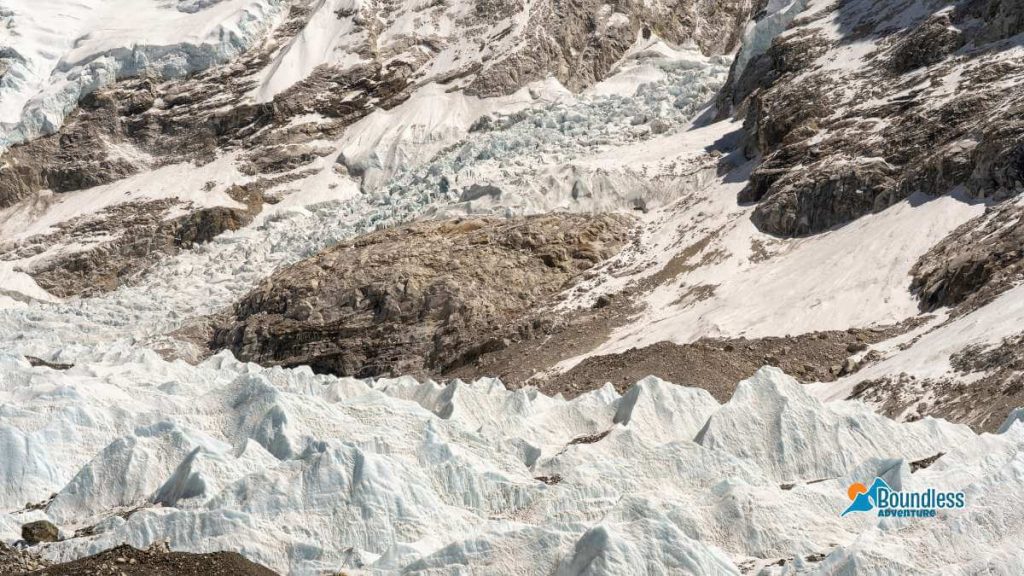
The Khumbu Icefall is one of the most dramatic and dangerous sections of the Khumbu Glacier, located between Everest Base Camp and Camp I. It is a constantly shifting maze of ice towers, deep crevasses, and seracs that move and break apart as the Glacier flows downhill. Because of the possibility of avalanches and ice failures, climbers must exercise caution when navigating this area, typically in the early morning, when the ice is most stable. In addition to being a vital route for climbers aiming to summit Everest, the Icefall offers a breathtaking illustration of the Glacier's dynamic nature.
What is the elevation of the Khumbu Icefall?
The Khumbu Icefall sits between 5,400 and 5,800 meters above sea level. At these heights, thin air and frigid temperatures compound the physical challenge for climbers, demanding a high level of acclimatization and fitness.
What is the temperature of Khumbu Icefall?
Temperature fluctuations play a significant role in the Glacier's behavior. At night, freezing temperatures stabilize the Icefall, making it safer to cross early in the morning. However, daytime warmth can loosen ice blocks, increasing the risk of serac collapses and avalanches.
What happened during the Khumbu Icefall Avalanche in 2014?
The Khumbu Icefall, a moving tangle of ice blocks and crevasses situated between Everest Base Camp and Camp I, is one of the Glacier's most dangerous areas. A terrible avalanche that tore through the Icefall in 2014 killed sixteen climbers. This incident highlighted the severe dangers posed by the Glacier's shifting ice, particularly when rising temperatures weaken enormous ice towers.
How many deaths have occurred in the Khumbu Icefall?
Over the years, the Khumbu Icefall has claimed many lives, earning its reputation as one of the deadliest parts of any Everest expedition. Its unstable ice, hidden crevasses, and sudden collapses create a hazardous environment where even expert climbers must proceed with utmost caution.
Trekking and Mountaineering Aspects
If you're doing the Everest Base Camp trek, you'll walk alongside the Khumbu Glacier for a significant portion of your journey. From Gorak Shep to Base Camp, the Glacier dominates the landscape, glimmering under the sun, echoing with cracks and shifts, and punctuated by prayer flags fluttering against a blue Himalayan sky.
For a better understanding of the area, check out this detailed map of Everest Base Camp that shows the surrounding landmarks, including the Khumbu Glacier.
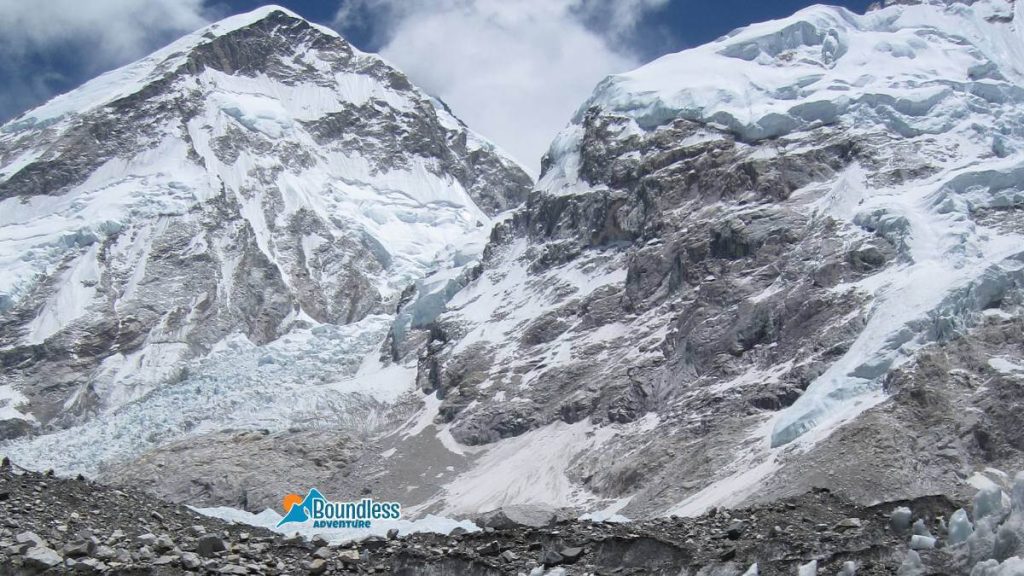
The trek offers several vantage points to view the Glacier, with Kala Patthar being the most popular. From this rocky peak, trekkers can enjoy panoramic views of Everest, Lhotse, and Nuptse, along with a sweeping view of the Glacier's snaking form.
While the trail near the Glacier isn't overly technical, the altitude and terrain demand respect. Proper acclimatization, hydration, and pace are key. It's here that Glacier trekking in Nepal becomes more than a catchphrase—it's a literal journey through an icy, living landscape, one footstep at a time.
Furthermore, the Glacier is necessary for mountaineering logistics. Base camps are established along the edge by Everest treks. The rhythmic sound of crampons on ice, the sight of colorful tents, and the occasional distant roar of an ice collapse all become part of the experience.
Environmental and Climate Concerns of this Icefall/Glacier
The Khumbu Glacier is in danger, just like many other Himalayan glaciers. According to recent studies, global warming is causing it to retreat at an alarming rate. In some sections, ice thickness is diminishing, and glacial lakes are forming, posing serious flood risks to downstream villages.
What's particularly concerning is the formation of supraglacial lakes (those on top of the Glacier), which can lead to glacial lake outburst floods (GLOFs). These floods can be catastrophic for communities in the lower Khumbu Valley, washing away homes, bridges, and trails in minutes.
In addition, the Glacier's retreat is impacting the long-term availability of freshwater for both people and ecosystems. The meltwater from the Khumbu Glacier feeds rivers that millions depend on, not just in Nepal but across South Asia.
Many locals have already observed changes—earlier snowmelts, unpredictable weather, and more frequent avalanches. The Glacier, once a reliable provider, is becoming an uncertain force.
Climate scientists and local organizations are now working together to monitor the Glacier's health, but the long-term picture remains uncertain. One thing is clear: the Khumbu Glacier is a front-line witness to the climate crisis.
Flora and Fauna in the Region
While the Khumbu Glacier itself is inhospitable to most life forms, the surrounding region is part of Sagarmatha National Park, a UNESCO World Heritage Site renowned for its rich biodiversity.
Above the tree line, hardy shrubs, mosses, and lichens cling to life. During the warmer months, alpine flowers bloom, splashing the rocky trails with bursts of color.
Wildlife in the region includes elusive creatures like the snow leopard, Himalayan tahr, and musk deer. High above, you may catch a glimpse of the Himalayan monal, Nepal's national bird, or a lammergeier soaring on the wind.
Yak caravans often pass through these trails, contributing to the local economy and ecology alike. These animals, adapted to harsh conditions, mirror the resilience of life surrounding the Khumbu Glacier.
The environment and the Glacier are closely intertwined. The delicate balance of life that has adapted to these harsh conditions changes together with the Khumbu Glacier.
Cultural and Socioeconomic Importance of This Glacier/Icefall
For the Sherpa communities living in the Everest region, the Khumbu Glacier holds not only geographical significance but also deep spiritual and cultural meaning. Many locals consider the mountains and glaciers sacred, as they are believed to be home to deities and ancestral spirits.
As tourism has grown, the Glacier has become a source of livelihood. Porters, guides, lodge owners, and shopkeepers all depend in some way on the trekking and climbing seasons. The route to Everest Base Camp, which winds near and around the Glacier, is a vital economic artery.
However, this rise in tourism has also brought challenges, including waste management issues, environmental degradation, and cultural shifts. Balancing these forces while respecting the land's sacredness is an ongoing challenge for the region.
Still, the Khumbu Glacier remains a symbol of resilience and adaptation for nature and people alike. For the younger generation, it represents opportunity and identity—a link to heritage and a gateway to the global mountaineering community.
Conservation Efforts for Glacier
Recognizing the urgent need to protect this critical environment, several local and international organizations are actively engaged in conservation efforts around the Khumbu Glacier.
The Sagarmatha Pollution Control Committee (SPCC), for instance, has implemented waste management systems to keep trekking trails and camps clean. Climbers are now required to bring down a certain amount of their waste from Everest, and there are increasing efforts to reduce plastic use.
Scientific studies and glaciological monitoring are conducted by institutions such as the International Center for Integrated Mountain Development (ICIMOD). Their work helps understand glacier behavior and project future trends.
Education is also essential. Local organizations are cultivating a new generation of environmentally conscientious tourists by educating trekkers about Leave No Trace principles and promoting responsible tourism.
Some conservation projects even involve local schools, instilling environmental values in young minds. In this way, safeguarding the Khumbu Glacier becomes a community-driven mission.
The sustainability of a complete ecology, economy, and culture depends on the preservation of the Khumbu Glacier.
13-Day Itinerary Including Khumbu Glacier During Everest Base Camp Trek
- Day-1: Arrival in Kathmandu and Pickup Service, Overnight at Kathmandu [1,400 m]
- Day 2: Fly to Lukla and trek to Phakding, Overnight [2,610 m]
- Day 3: Trek From Phakding to Namche Bazar, Overnight. [3,440 m]
- Day 4: Acclimatization Day in Namche Bazaar [3,440 m]
- Day 5: Trek from Namche Bazaar to Tengboche, Overnight. [3,860 m]
- Day 6: Trek to Dingboche, Overnight. [4,410 m]
- Day 7: Acclimatization at Dingboche, Overnight. [4,410 m]
- Day 8: Trek from Dingboche to Lobuche, Overnight. [4,940 m]
- Day 9: Trek from Lobuche to Everest Base Camp, with Khumbu Glacier on the way + Gorakshep, Overnight. [5,364 m]
- Day 10: Trek to Kalapatthar and Pheriche, Overnight. [5,545 m]
- Day 11: Trek to Manjo, Overnight. [3,440 m]
- Day 12: Descend to Lukla, Overnight. [2,610 m]
- Day 13: Fly back to Kathmandu, Overnight. [1,400 m ]
- Day 14: Departure
For detailed itinerary information
Conclusion
The Khumbu Glacier is full of adventures, narrates tales, and symbolizes the Earth's fragility and beauty. Whether you're gazing at it from Kala Patthar, crossing the daunting Khumbu Icefall, or simply learning about it from afar, this Glacier invites awe, respect, and reflection.
As you plan your journey into the Himalayas, remember that every footprint you leave near the Khumbu Glacier touches a living, shifting landscape that connects people, nature, and the climate in a powerful web.
So travel mindfully. Stay informed. And let the Boundless Adventure leave its mark on you, just as you do on it.
FAQs
The Khumbu Glacier extends approximately 17 kilometers, beginning high in the Western Cwm near the base of Mount Everest at around 7,600 meters elevation and flowing down through the Khumbu Valley to about 4,900 meters near Lobuche village. As the world's highest Glacier, it has shaped the terrain that many hikers and climbers traverse, forming a unique route that combines breathtaking natural beauty with high altitude.
Ask Question


Let's Plan Your Trip Together
Tell us what you're looking for, and we'll help you shape a journey around it.
Plan with us